Matcha is having an unusually profitable moment.
Starbucks said during its October 2026 earnings call that matcha had grown into a business exceeding $1 billion. Earlier in the year, the company reported that tea revenue had risen more than 70 percent across its U.S. company-operated coffeehouses. Matcha had expanded from a straightforward green tea latte into a platform spanning cold beverages, fruit flavors, protein additions, cold foam, and food.
Those numbers are impressive. They are also easy to misinterpret.
The lesson for an independent café is not to reproduce Starbucks’ menu, buy six powders and create a wall of green beverages. It is to understand why a platform can be more valuable than a single popular drink.
Starbucks is using matcha to address several commercial questions at once:
- What can attract customers after the morning coffee peak?
- What can support customization?
- What can justify a larger size?
- What drinks can easily attach to entres?
- What can feel new and trendy without requiring an entirely new production system?
That is the opportunity worth studying.
A platform is different from a product
A product is one recipe. A platform is a controlled set of variations built from shared ingredients, equipment, and labor.
For a small café, a matcha platform might contain only three drinks:
- A classic iced matcha latte.
- A fruit-forward matcha using one existing syrup or purée.
- A premium version with cold foam or another profitable modifier.
The three drinks should share most of their inventory. The platform becomes attractive when customers perceive meaningful choice while the operation avoids three completely separate recipes.
That is a crucial distinction. Menu variety is not automatically valuable. Variety becomes valuable when it produces more occasions, a higher average check, or wider appeal without creating disproportionate waste and training.
The afternoon matters more than the color
Coffee shops often concentrate their energy on the morning. That is logical: commuters want caffeine, breakfast, and speed. But the same store, equipment and lease continue through the afternoon, when traffic may slow down.
Starbucks executives connected matcha’s growth with afternoon demand. The drink behaves differently from a routine morning coffee. It can feel refreshing, indulgent, social, and customizable. Cold formats also tend to support larger sizes and visual distinction.
An independent café should therefore ask a more useful question than “Should we sell matcha?”
Ask:
“What beverage could give our customers a reason to visit between 1 and 5 p.m.?”
Matcha may be the answer. So might chai, cold brew, fruit tea, lemonade, drinking chocolate, or a seasonal beverage base. The principle is to develop an afternoon occasion, not merely another line on the menu.
Measure whether the test creates incremental afternoon transactions. A popular drink that only replaces existing iced coffee sales may improve mix or margin, but it has not necessarily created a new visit.
Customization can be a margin system
Customization is often discussed as customer experience. It is also menu engineering.
A cold foam, fruit layer, flavor addition, alternative milk, or protein modifier can increase perceived distinction more than it increases ingredient cost. That does not make every modifier profitable. Each must be portioned, timed, and costed.
For every addition, calculate:
- Ingredient cost per measured portion
- Cup, lid and straw cost
- Added preparation time
- Waste and shelf life
- Selling-price increase
- Effect on throughput
- Frequency with which customers select it
If a modifier adds 35 cents in ingredients and packaging but commands $1.00, it appears attractive. If it also adds 45 seconds during the busiest hour, spills frequently, and creates remakes, the real contribution is smaller.
The best modifiers are visually or sensorially meaningful, easy to explain, and compatible with several drinks. One cold-foam system that works across matcha, cold brew, and iced coffee may be stronger than a specialized topping used once.
Bigger is useful only when bigger contributes
Cold beverages often encourage larger sizes. That can help average ticket because the added liquid and ice may cost much less than the price difference between sizes.
But owners should verify the economics rather than assuming them.
Measure the recipe at every size. Some cafés accidentally increase expensive powder, fruit or foam faster than the selling price increases. Others use the same modifier quantity across sizes, causing the larger drink to look underbuilt.
Create a simple size ladder:
| Measure | Small | Medium | Large |
|---|---|---|---|
| Selling price | |||
| Ingredient cost | |||
| Packaging cost | |||
| Contribution dollars | |||
| Preparation time |
The goal is not to push every customer toward the largest cup. It is to make each size economically coherent.
Matcha also creates a food opportunity
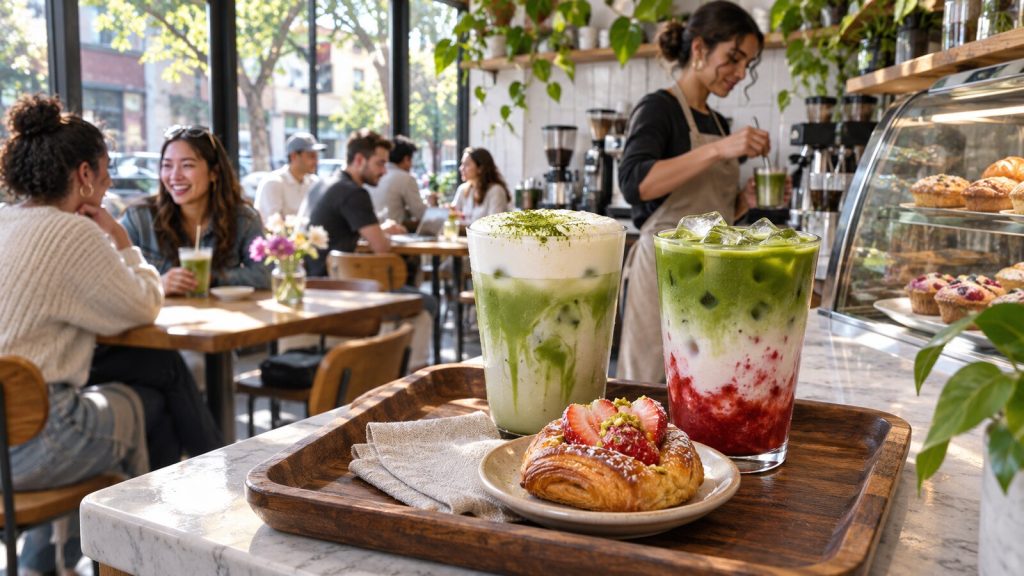
Starbucks has extended the platform beyond drinks, including matcha-related food. An independent café does not need to imitate that breadth, but it should consider attachment.
An afternoon beverage can pair with:
- A small pastry
- A tea cake
- A cookie
- A light savory item
- A snack box
- A limited seasonal bake
The pairing should feel natural, not forced. A bundle is not required; suggestive merchandising may be enough. Place the beverage and food together in photography, train staff on one simple pairing and measure food attachment during the targeted daypart.
Do not assume a discounted bundle is necessary. If the products complement each other and the occasion is clear, convenience and suggestion may do more work than price reduction.
A narrow test is better than a sprawling launch
The danger of a trend is that enthusiasm outruns operational discipline. Owners see momentum and order multiple powders, purées, cups and toppings before learning whether local customers care.
Use a three-drink test:
Drink 1: The baseline
A simple, well-executed classic. It establishes whether the base product has demand.
Drink 2: The accessible variation
Use one familiar flavor or ingredient already present in the café. This may attract customers who find classic matcha too earthy.
Drink 3: The premium variation
Add one visible, high-perceived-value modifier such as cold foam.
Run the test for four to six weeks. Avoid launching during an abnormal holiday, closure or major local event if you want results that represent normal demand.
Track:
- Units sold by drink and size
- Sales by hour
- Modifier rate
- Food attachment
- Ingredient waste
- Preparation time
- Remakes
- Contribution dollars
- Whether buyers are new, returning or shifting from another beverage
The last measure matters. A test can look successful while merely moving existing customers from one menu item to another.
Protect quality before adding flavors
Matcha exposes preparation inconsistencies. Poor whisking, imprecise powder portions, water that is too hot, weak color, undissolved clumps, and uneven sweetness can make the same drink vary from employee to employee.
Before expanding, establish:
- Exact powder weight
- Water temperature and volume
- Mixing method and time
- Milk and ice quantities
- Sweetness standard
- Build order
- Finished appearance
- Maximum service time
Then taste the drink after five, ten, and twenty minutes. Cold drinks change as ice melts and foam settles. If many customers order for pickup, the delayed experience matters.
A platform amplifies both strengths and defects. Three versions of an inconsistent base create three inconsistent products.
Do not turn the café into an ingredient warehouse
The platform should reduce complexity through shared components. Set a rule: every new ingredient must support more than one item or prove enough sales to justify its space and shelf life.
Before approving a new ingredient, ask:
- Can it be used in another beverage or food item?
- How quickly must it be used after opening?
- What is the minimum order?
- Does it require refrigeration?
- Can staff portion it accurately?
- What happens to it if the test ends?
This is where an independent café can outperform a large chain. It can test on a smaller scale, listen closely and remove weak variations quickly. Its advantage is not purchasing power. It is the ability to learn without building a national system.
The real lesson
Starbucks’ billion-dollar matcha business does not prove that matcha will work everywhere. It shows the commercial power of an adaptable beverage base tied to a daypart, profitable customization, size architecture, and food attachment.
The independent version should be smaller and more disciplined.
Choose one base. Build three purposeful variations. Cost every modifier. Target a specific afternoon occasion. Measure whether the platform creates additional visits and contribution—not merely attractive photographs.
The opportunity is not to chase a green drink. It is to build a beverage system that gives customers another reason to visit.
Sources
Put your next menu idea through a profit check.
A popular drink is a revenue opportunity. Whether it belongs on your menu depends on your customers, costs, and operations. The Restaurant AI Toolkit includes menu contribution, guest feedback, and prep workflows to help you intelligently work through a proposed offer and plan a manageable test. Give your next beverage idea a clearer business case before investing in ingredients, training, and promotion.