Your restaurant menu does not mention diesel. Your guests don’t order a side of freight, and your recipes don’t list refinery margins in the ingredients. Yet, diesel costs can raise the cost of nearly everything that crosses your receiving door—often before the food itself becomes more expensive.
This really hurts when fuel markets are volatile. On October 26, 2026, the U.S. Energy Information Administration reported an average on-highway diesel price of $6.352 per gallon, up 7.6 cents in one week and $2.63 from a year earlier. The Midwest average reached $6.480. Those numbers do not tell a restaurant owner exactly what next week’s lettuce, chicken, or takeout containers will cost. They do warn that the expense of moving those products is under pricing pressure.
The first increase may not appear where you expect it.
The ingredient price and the delivered price are different
Suppose your distributor’s quoted price for a case of chicken breasts is unchanged. It is tempting to conclude that chicken costs are stable. But the case does not arrive by itself. It travels through a supply chain that may include a processing plant, refrigerated storage, a distribution center, and a diesel-powered delivery route.
The amount you ultimately pay can be separated into 5 layers:
- The underlying commodity or farm value.
- Processing, grading, packaging and storage.
- The distributor’s acquisition cost and margin.
- Transportation and refrigerated delivery.
- Fuel, energy, minimum-order and stop charges.
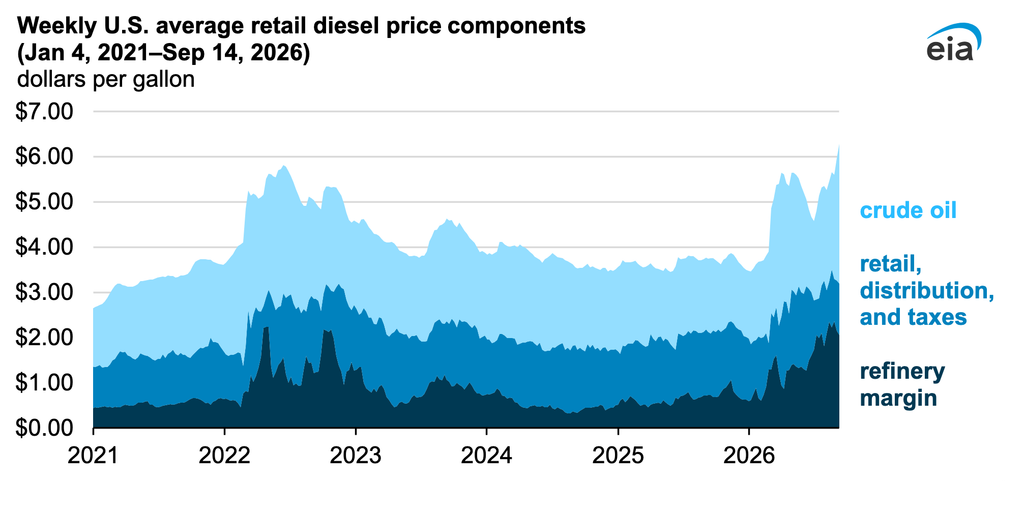
Any one of those layers can shift while another remains stable. A softer wholesale chicken market does not prevent a distributor from paying more to operate its fleet. Likewise, a falling crude-oil quote does not guarantee that diesel will immediately become cheaper. EIA explains that diesel reflects crude cost, refinery economics, distribution, marketing, retail costs, and taxes. Tight distillate supplies or high refinery margins can keep diesel elevated even when the crude story appears less dramatic.
Why the surcharge can arrive first
Many carriers and delivery companies use a fuel surcharge to adjust transportation charges as diesel moves. EIA publishes the weekly diesel data often used in those formulas, but it does not set or regulate the formulas. Each company can choose its own baseline, index, geographic average, adjustment interval, and method.
That creates several possibilities for a small restaurant:
- A separate fuel surcharge appears on the invoice.
- A delivery charge increases.
- A minimum-order threshold rises.
- A formerly free delivery becomes conditional.
- Freight is embedded in the case price and becomes difficult to see.
- A vendor changes route frequency or delivery windows to reduce its own costs.
The timing can be quick. A surcharge tied to a weekly index may change within days. Packaged products may react more slowly because manufacturers, warehouses, and distributors have inventory purchased under earlier conditions. Imported items can carry an even longer lag. The result is a messy sequence rather than one clean price increase.
This is why waiting for a food-cost percentage to worsen can leave an operator several weeks behind the cause.
The same truck carries both cheap and expensive food
Freight does not care whether an ingredient has a high menu price or generous profit margins. A delivery truck consumes fuel while carrying inexpensive cabbage, premium beef, paper napkins and fryer oil. Transportation pressure can therefore weigh disproportionately on bulky, heavy, refrigerated or low-margin products.
Consider four key characteristics:
Weight and volume. Beverages, oil, canned goods and some disposables occupy space and add weight even when the unit value is modest.
Temperature control. Refrigerated and frozen goods require both transportation and energy-intensive handling.
Delivery frequency. A product that forces an extra stop or small emergency delivery may carry more hidden cost than an item arriving on a consolidated order.
Distance and route density. The economics of serving ten customers on a compact urban route differ from serving scattered accounts over a long distance.
Now, this does not mean you should eliminate low-priced or heavy products. It means the purchasing decision should factor in delivered cost and order patterns, not merely the vendor’s line-item quote.
What to look for on the invoice
Pull the last four invoices from each major distributor. Do not begin with the food. Begin with every line that is not food.
Look for:
- Fuel surcharge
- Delivery or transportation charge
- Energy or environmental fee
- Small-order fee
- Minimum-order adjustment
- Refrigeration or frozen-goods charge
- Split-case fee
- Emergency-delivery charge
- Price changes on packaging, paper, and other freight-heavy supplies
Then ask the vendor four direct questions:
- What published index, if any, determines this fee?
- What is the baseline fuel price and how frequently is the surcharge adjusted?
- Does the charge automatically fall when the index falls?
- Can the fee be reduced through a larger order, fewer weekly stops, or a different delivery day?
A vague answer does not prove that a charge is improper. It does mean you cannot manage the expense intelligently. A formula-based fee should be explainable.
Consolidate carefully—not blindly
Combining deliveries can reduce stop costs, but ordering more is not automatically economical. Extra inventory can create spoilage, storage problems, cash-flow pressure, and invite theft. The right question is not, “Can we order once instead of twice?” It is, “Does the avoided fee exceed the cost and risk of holding the additional product?”
For shelf-stable goods, disposables, and predictable high-volume items, consolidation may be straightforward. For fragile produce, fresh seafood, or items with uneven demand, a second delivery may still be worth paying for.
The same logic applies to chasing a lower-case price from a distant specialty supplier. Once you factor in freight, minimums, and receiving labor, the apparent bargain may disappear.
Delivery economics belong on the menu too
Diesel pressure does not stop at your receiving door. If your restaurant delivers food, fuel also affects the trip to the guest. A flat delivery fee that worked when fuel was cheaper may no longer cover the true cost of distant orders.
Review delivery contribution by zone and order size. Include:
- Driver wage and payroll burden
- Mileage or vehicle cost
- Fuel
- Packaging
- Payment processing
- Refunds and remakes
- Platform fees, if applicable
- The food’s contribution margin
The answer does not have to be a blanket fee increase. A restaurant might narrow its service radius, raise the minimum for distant zones, promote pickup, schedule catering routes more efficiently, or reserve in-house delivery for orders with enough contribution to support it.
Build an energy-to-invoice watchlist
A restaurant owner does not need to become an oil trader. The useful discipline is much simpler.
Each week, record:
- The national or regional EIA diesel price
- Fuel and delivery fees from major suppliers
- Delivered prices for five high-volume items
- Packaging and cooking-oil prices
- Number of deliveries and emergency orders
- Delivery cost as a percentage of purchasing
After four to eight weeks, patterns become visible. You may find that a distributor raises a surcharge quickly but lowers it slowly. You may discover that emergency produce runs cost more than the ingredient variance they were meant to solve. You may learn that one vendor’s case price is higher but its all-in delivered cost is lower.
That information is more actionable than a frightening oil headline.
The practical lesson
Diesel does not read your menu, but it touches the path that food, supplies, and finished orders travel. When fuel rises, don’t assume every ingredient will immediately cost more. Don’t assume a stable commodity quote protects you either.
Trace the increase layer by layer. Separate the product from the transportation. Audit the fees before they blend into food cost. Then change ordering frequency, vendor terms, delivery zones, or menu decisions only where the numbers justify it.
The goal is not to predict the energy market. It is to recognize where energy has already entered your restaurant’s economics.
Sources
- U.S. Energy Information Administration: Gasoline and Diesel Fuel Update
- U.S. Energy Information Administration: Diesel Fuel Surcharges
- U.S. Energy Information Administration: What Goes Into Diesel Prices?
Find out what’s really driving your supplier bill.
You can’t control diesel prices, but you can get clearer about what you’re paying—and where you have room to act. The Restaurant AI Toolkit gives you guided workflows for reviewing invoices and evaluating suppliers using your own records. Turn the next price increase into a focused review of charges, ordering patterns, and purchasing options before deciding what to change.