Historically, chicken thighs earned their restaurant reputation honestly. They are flavorful, forgiving on the line, and well suited to grilling, roasting, frying, braising, and sauced dishes. For years, many operators also considered them the economical alternative to breast meat.
That last assumption is no longer safe.
USDA-derived wholesale trading for the week ending October 30, 2026, placed boneless skinless breast meat near $1.12 per pound and boneless skinless thigh meat near $1.71. Those are national FOB-plant benchmarks, not the delivered prices a restaurant necessarily pays. They nevertheless reveal an important reversal: boneless thigh meat carried a premium of roughly 59 cents per pound.
The point is not that thighs have become a bad product. The point is that “dark meat is cheaper” is a convention, not a costing method.
Why old pricing pillars can collapse
Food-cost assumptions often outlive the markets that created them. A formerly overlooked cut becomes popular. Restaurants redesign menus around it. Retail demand strengthens. Processors face limits on how much of one cut each bird can supply. Eventually, the economical substitute attracts enough demand to lose some of its price advantage.
Boneless thigh meat also is not interchangeable with every other dark-meat product. Removing bone and skin adds processing and changes yield. A quote for bone-in thighs, leg quarters, or boneless skinless thighs describes a different item with different labor, transportation, and market demand.
At the same time, breast production can be abundant. Larger birds produce substantial breast meat, and changing retail or export demand can soften one cut while another tightens. The markets diverge even though the meat comes from the same bird.
That is why small independent restaurant operators should stop asking, “What is chicken doing?” and start asking, “What is my exact specification doing?”
Purchase price is only the first number
The lower case price does not always produce the lower plated cost. To compare breast and thigh meat fairly, calculate the cost of a usable cooked portion.
Start with:
Delivered price. Include freight, fuel, split-case and minimum-order charges allocated appropriately.
As-purchased yield. Account for trimming, excess fat, inconsistent sizing and purge.
Cooking loss. Weigh a representative batch before and after cooking under normal line conditions.
Labor. Include trimming, portioning, pounding, marinating, skewering or other cut-specific prep.
Portion consistency. Irregular pieces may create overportioning or an uneven guest experience.
Supporting ingredients. A cut that needs more sauce, breading, oil or garnish can erase a protein-price advantage.
The usable-cost formula is straightforward:
Usable cooked cost per pound = delivered cost per pound ÷ cooked yield percentage
If a product costs $1.70 per pound delivered and yields 72 percent after trimming and cooking, the usable cooked cost is approximately $2.36 per pound. At a five-ounce cooked portion, the protein cost is about 74 cents before marinade, breading, sauce, and labor.
Use your own test numbers. The formula matters more than the example.
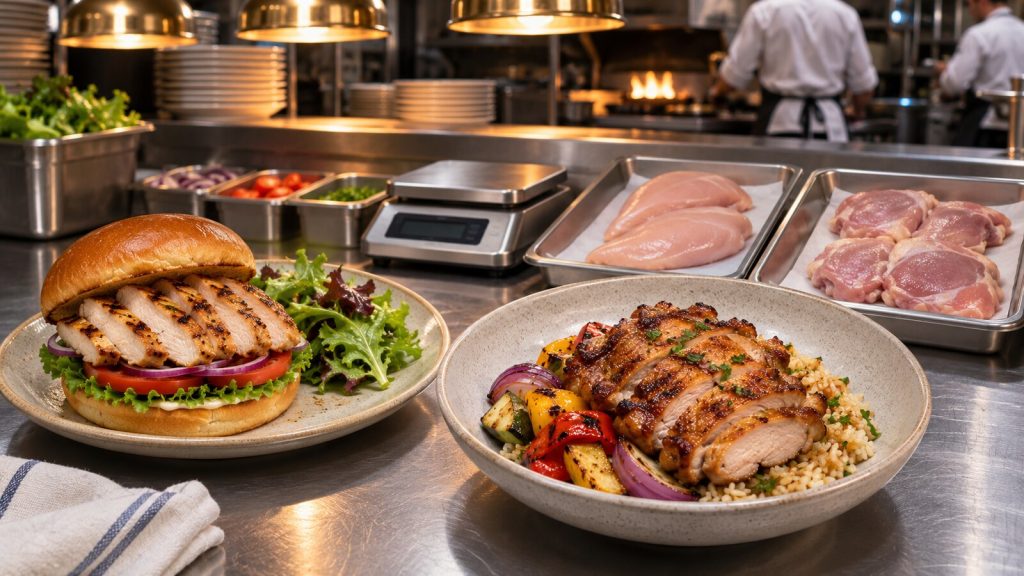
Breast meat may create options beyond the entrée
When breast is favorably priced, its value is not limited to replacing thigh meat ounce for ounce. Its shape and mild flavor can support several formats:
- Grilled or fried sandwiches
- Cutlets and schnitzel-style plates
- Sliced salad or bowl proteins
- Chicken Parmesan and other composed entrées
- Skewers
- Portion-controlled catering trays
- Add-on protein for pasta, rice and vegetables
The merchandising opportunity comes from controlling the portion and building perceived abundance around it. A sliced four- or five-ounce breast over grains and vegetables may appear more generous than a larger intact piece. A sandwich can use texture, sauce and garnish to create value without increasing protein weight.
That does not mean every menu needs more breast meat. It means a cut that operators have treated as expensive deserves a fresh costing when the market changes.
Thighs still have operational advantages
Price is not the only reason to choose a cut. Thigh meat tolerates longer cooking and holding, remains moist under demanding service conditions, and handles strong marinades well. Those attributes can reduce remakes and execution failures.
A breast product that is cheaper on paper can become costly if the line routinely overcooks it. Conversely, a thigh dish that requires substantial trimming or produces inconsistent portions can carry hidden labor and yield costs.
The right decision depends on your restaurant’s equipment, skill, volume, and service model.
For example:
- A high-volume sandwich shop may benefit from calibrated breast fillets that cook consistently.
- A catering operation may value thigh meat’s holding tolerance.
- A bowl concept may prefer sliced breast for visual coverage and portion control.
- A scratch kitchen may turn bone-in thighs into a profitable braise if labor and cooking capacity are available.
The market price starts the analysis. The operation finishes it.
Run a controlled kitchen comparison
Do not reengineer the menu from a supplier quote alone. Test the alternatives under the conditions your staff actually faces.
For each cut:
- Purchase the normal case or a representative sample in the exact specification being considered.
- Record delivered weight and price.
- Weigh trim and unusable loss.
- Portion using the method staff would use in production.
- Cook the batch with the actual equipment and recipe.
- Record finished weight and number of acceptable portions.
- Time the labor.
- Hold the product for the realistic service period.
- Evaluate taste, appearance and texture.
- Calculate the complete plate contribution.
Test delivery quality as well. A cut that performs beautifully at the pass but deteriorates after 20 minutes may not suit a delivery-heavy concept.
Compare contribution—not food-cost percentage alone
Suppose a breast-based entrée has a slightly higher food-cost percentage but sells at a higher price and contributes more dollars after variable food cost. It may be the stronger menu item. Or a thigh dish may have excellent food cost but require enough trimming and labor to reduce its practical value.
Track at least four key outcomes:
- Contribution dollars per sale
- Contribution per labor minute
- Sales mix and guest acceptance
- Remake, waste, and complaint rate
An ingredient substitution that lowers theoretical food cost but weakens the item’s appeal is not an improvement. Neither is a fashionable cut that sells well but produces little contribution.
Ask the supplier better questions
Instead of asking for “the cheapest chicken,” ask:
- What exact breast and thigh specifications are most favorable this week?
- What size ranges are available?
- Is the quote fresh or frozen, and how does that affect shelf life and yield?
- Are there pack sizes that avoid split-case charges?
- What is the recent price direction for each cut?
- Is a contract price advisable, or is the market currently softening?
- Are tenders, drumsticks, leg meat or whole birds better values for the intended dish?
A knowledgeable representative should be able to discuss specifications, not merely recite a price.
Replace permanent beliefs with scheduled reviews
Every restaurant has at least some level of inherited kitchen wisdom: thighs are cheap, wings are expensive, eggs have great margins, beverages pay the bills. Each statement may be directionally useful at one point in time, but misleading at another.
Create a quarterly cut review for your largest protein purchases. Compare delivered price, cooked yield, labor, and contribution. Review sooner when markets move sharply, or a supplier offers a materially different specification.
The lesson from today’s thigh premium is certainly not “buy breast forever.” Markets can reverse again. The lesson is to stop granting any cut a permanent place on the menu based solely on the price hierarchy.
Chicken thighs remain an excellent ingredient. Chicken breasts may offer unusual value. Your menu should reflect what each cut does for the guest and the operation now—not what everyone assumed it cost three years ago.
Sources
- USDA Agricultural Marketing Service: Chicken Market News Reports
- USDA Agricultural Marketing Service: Poultry and Egg Market Terms
- USDA Economic Research Service: Livestock and Meat Domestic Data—Documentation
- USDA Economic Research Service: Meat Price Spreads
Which Cut Earns a Spot on Your Menu?
A lower price per pound can still produce a more expensive plate. Before switching cuts, compare portion costs, preparation requirements, and what each dish contributes after its costs. The Restaurant AI Toolkit’s menu contribution and prep workflows give you a structured way to examine your own numbers, check the calculations, and plan a small test before changing the menu.